Solicitation for Payment to Promote Artists – Use Caution

Media, News and Updates

Over the last few years I have been receiving sporadic emails inviting me to have my work published and / or displayed in some form of publication on a cost to the artist basis. These emails almost always begin with ‘You have been specifically chosen from amongst thousands of artists‘. These solicitation emails have historically utilised printed media such as magazines and quote ‘ Art Books’ as their publishing platform. The long and short of this approach should you be unfortunate to receive one of these email invitations is that the artist or photographer is approached (usually via email) with an offer to have their work published in a quote ‘respected’ book or magazine. The offer often goes into quite some detail about the ‘extensive’ circulation of the publication, the importance of being included and the exposure that comes from having ones work displayed in the publication. The artist / photographer is presented with a number of different offers that range from a single page of publication to multi-page spreads at a cost of usually $600-$900+ USD per page. There is usually significant embellishment by the seller on the number of galleries the publication is distributed to as well as the extensive number of art purchasers who subscribe to the publication. The entire package is then dressed up for sale and proffered as an exclusive opportunity to the artist / photographer. Most of these books that I have researched are in excess of 300 pages which gives an idea of just how many artists you would be competing with should you pay to have your work included. Some simple math indicates that even at the lower end of $600 per page these publishers are raking in around $180,000 USD in revenue (and many of them are upwards of $900 per page and well in excess of 300 pages). With book publishing being as cheap as it is today in China  you can bet that less than a quarter of that is being spent on the actual publication. It doesn’t require much thought as to where the rest of it ends up. I did some checking with galleries here in Australia as well as those in New York and other prime locations. Most had never heard of the short list of ‘Art books’ I had been approached by and those that had did not have kind things to say about them; suggesting quite bluntly they were a complete waste of money and that any artist who was seeking representation should contact them directly for folio appraisal.

I am going to refrain from naming some of these publications even though I have both direct and indirect experience with quite a few of them. You should be able to quickly recognise these publications for what they are in how they market and present themselves. These publications prey on the often fragile ego of the artist photographer hoping to be recognised and to stand out from the crowd. The sales pitch is designed to entice the artist to part with their money in exchange for having their work published and distributed to an often unknown network that is difficult to verify. There is almost never any offer of follow up after publication to verify the distribution or of offers to work with the artist who is usually seeking gallery representation. I know of one recent example whereby a good friend paid to have his work printed in what was supposedly a well respected magazine. Despite making his substantial payment in full no magazine has been published to date and all requests for a refund have gone unanswered. In this magazine’s defence I believe they did release a digital PDF version after complaints from many of the contributors (all of whom payed to be published). Who this was distributed to remains unknown and wether an actual magazine will ever be printed remains unlikely. Either way, my friend is unlikely to get value for his money and even less likely to get his money back.

My advice if you are considering paying to have your work published is that you look very closely at the distribution of the media you are considering being a part of. The very first thing you should do on receiving any email that offers you publication in exchange for money is to Google the publication and find what experience other artists have had in dealing with them. I guarantee you will find someone out there who has been approached and written about their experience to help others. Put zero credence in their own website testimonials unless they include a full name and email link to contact the artist to verify the quote. Testimonials without  a full name and email address for verification are worth less than the virtual paper they are printed on.

More recently I have started to receive solicitation emails that are utilising the Apple APP store as the publishing platform. The email offer entices the artist / photographer to have their very own app developed comprising of their work. The company making the offer will design and build the app on behalf of the photographer and take a heavy percentage of any sales on top of a substantial up front development fee. On the face of it this may seem a fair deal. However, you should be sure to read the fine print about who owns the copyright to displayed work and what you are really signing up for. If you are approached with such an offer I suggest exercising caution. Be sure to do your due diligence. Try and speak with photographers or artists who have  paid to to use the medium and find out what they really got out of it. There are many application development kits now on the market that require even less work than setting up a website and I recommend you look into these before you hand over potential profit from sales of your work to a third party. The last such offer I received turned out to be using nothing more than an Adobe application for single issue publication called Adobe DPS Single Edition. This easy to use tool can be used by anyone to create their own application without development costs above those from Adobe for the software and Apple for access to iTunes. You don’t even need to know how to write code.

There are of course many legitimate reasons to pay for publication of your work. Just be very clear in your mind what you are hoping to achieve by having your work published if you intend to pay for the privileage. If it is purely ego driven then perhaps paying to satisfy this need is justifiable. But, if you are paying to publish your work in the hopes of recognition or with a plan to increase your exposure and publicity then I would think very hard about it before you make a financial investment. You are likely to get far more benefit from publishing your own book (or e-book!), or contacting a gallery or agent directly than you will ever get from being included in a artists book that showcases the work of many artists. There are a myriad of options out there for artists who want to promote their work and increase their exposure. Many of them require no where near the upfront investment some publications are asking. There are many roads to recognition for the promotion of artists – consider your options carefully and ask yourself what you are really trying to achieve before you part with your hard earned money to promote your work.

February Photo of the Month: Petermann Island Antarctica

Antarctica, Landscape Photographs, News and Updates, Photographs, Travel Photography, Wildlife Photographs

My photograph of the month for February is of a Penguin rookery high on the mountain side at Petermann Island in Antarctica. Petermann Island is one of those incredible Antarctic locations where it is possible to go ashore and wander amongst the many Penguin rookeries making photographs. In this instance, we landed late in the evening via zodiac at Petermann Island and spent several hours photographing the landscape and penguins as the sun slowly set in perfect weather conditions. This photograph was taken around 11pm at night and illustrates just how much light is available this late in the evening in Antarctica. We were very fortunate during this landing to have just about perfect conditions with wonderful light and atmospherics. Dedicated expeditions for photography such as this one (Read the Report) are the key difference between capturing images such as this in ideal lighting conditions and just snapshots taken in the middle of the day. If you are interested in travelling to Antarctica for photography I am running two expeditions to the great white continent this year. The first is an extended expedition to South Georgia Island and Antarctica with my good friend Andy Biggs. The second is a shorter expedition to the Antarctic peninsula with fellow Australian photographer Antony Watson. Full details, including an itinerary is available for download on the workshops page of my website at www.jholko.com There are only very limited places remaining on both expeditions. If you want to get more of an idea what it is like to travel on a dedicated photography expedition be sure watch the Polar Experience Video I produced late las year.

FujiFilm Australian Landscape Photographer of the Year 2013

News and Updates

Just over a month ago I helped judge the Fujifilm Australian Landscape Photographer of the Year Competition for Australian Photography + Digital Magazine and the winners have now been announced. Congratulations to Debbie Fowler who is the inaugural winner of the prestigious Australian Photography + digital Fujifilm X Landscape Photographer of the Year award. She won with her aerial abstract series, which she shot whilst on an open-door helicopter flight above the Cambridge Gulf in far northwest Australia. Second place overall went to Helen McFadden, who shot a series of icy images made in Godhul Bay, South Georgia island, north of Antarctica and east of the South American continent. The other eight finalists to make the top ten included Brad Grove, Matthew Smith, Luke Tscharke, Shirley Milburn, Aaron Huang, Andrew Dickman, Judith Conning, and William Patino. The top twenty five portfolios included Peter Hill, a second portfolio from Aaron Huang, Nick Baldas, Derek Feebrey, Francis Pisani, Tim McCullough, Peter Hammer, Ben Taylor, Priyaji Peiris, Michael Harris, Cameron Downie, Chris Wiewiora, Margot Hughes, Jason Beaven, Kiall Frost. My congratulations to all of these photographers.

The competition was open to amateur photographers only and true to its name sake was out to find the 2013 Australian amateur landscape photographer of the year. I know the term professional photographer is somewhat convoluted these days but Australian Photography Magazine define it as: Professional photographers are not permitted to enter. By entering this competition the entrant guarantees that he/she is not a professional photographer. For the purposes of this competition a professional photographer is someone who earns more than $2000 a year from photography. By that definition we can assume that all entrants into this competition earned less than $2000 with their photography in the year of entry. This is an important distinction as this point rules out many very fine photographers who make some (albeit a meagre) income (above $2000) from the pursuit of their passion but fall far short of being able to sustain and support themselves without some other supplementary income (usually a full time job). I emphasise this point as this competition is one truly open to amateurs only.

This was not the first time I have  been invited to judge a photographic competition (and I hope it wont be the last!) but it was the first time I have judged a competition whilst I have been on a photographic expedition. In this case, I had just completed two spectacular weeks in Antarctica (Read the Report) surrounded by fifty other passionate photographers. Emotionally this time away on an expedition spent with a passionate group of participants put me in a very creative frame of mind and I felt charged and dare I say it perhaps even qualified to judge the photographs entered into the competition and prepare my thoughts on the winning images.

Whilst I was viewing the photographs it struck me that those images that were most successful were those that stepped beyond the obvious cliché and triggered an emotional response in the viewer (in this case me). I wrote briefly about this for Australian Photography Magazine and my orginal text is included below:

Firstly, thank you for the invitation to judge this competition and for the opportunity to present my thoughts on the judging process in relation to the submitted entries. It is very easy to wowed as a judge by exotic locations and having been fortunate to travel to, and visit many of the places depicted in the images submitted by many of the contestants I feel qualified to comment on how the image has been executed – composition, light, the ability to see past the obvious cliché. Travel to exotic photography destinations is perhaps half the battle. But it is on location where the magic of light and composition have to come together to create something truly special in landscape photography. It takes a keen eye and the ability to successfully translate a three-dimensional scene into a two-dimensional image that maintains a sense of depth and movement.  Being able to see past the obvious and capture form, shape and texture sets the best work apart from merely technically competent work. I was very pleased to see a selection of images in the competition that clearly demonstrated this skill and ability.

As a judge I am looking for images that demonstrate not only technical excellence, but also that evoke an emotional response in the viewer (In short, images that challenge the viewer and make them stop and think). A photograph that is well composed with a strong subject and great light really shines when the photographer also manages to capture the mood and feeling of a location. I look for a sense of depth, movement and design (once the technical aspects have been assessed) when judging images and those photographs that successfully convey this always stand out. Photographs that pose a question or that cause the viewer to pause and consider what it is that they are viewing are always far more powerful than just a pretty scene.

FujiFilm Australian Amateur Landscape photographer of the year is not a title to be bestowed lightly. Although this competition is not open to professionals I viewed all images with the eye of a professional full time nature photographer and it was very pleasing to see such a solid standard of work. The line is very blurred these days between amateur and professional photographers and I regularly see work from amateurs of the highest calibre. I am pleased that this competition has attracted this high standard of work and it was my pleasure to view and judge the photographs. I commend all the photographers who entered and encourage them to do so again next year. Thank you.

Not long after I had finished judging the competition and had forwarded my thoughts above to Australian Photography Magazine I came across a fascinating article by photographer David Ward. I was sitting in the airport at Punta Arenas in Chile waiting for my connecting flight to Santiago last December and was reading issue #65 of On Landscape magazine (one of the finest publications on landscape photography to grace the halls of landscape literature in my view). Of particular interest was an article by David titled ‘Leaving Room, Where Does the Viewer Live?’. I have not yet had the pleasure to meet David but his article strikes at the very core of what I was driving at when I wrote the above statement about judging the Fujifilm Landscape Photographer of the Year competition.  Landscape photography is about so much more than just a pretty or dramatic picture and David’s article sums this up succinctly and in such a way that the photographer can take many pearls of wisdom away from the article and apply them to their own phtoography. If you do not subscribe to On Landscape I highly recommend you do so and read David’s excellent article. Issue #66 also includes an excellent article on judging Competitions titled ‘The View from the Other Side” by Tim Parkin that is well worth a read for any would be contestant entrant as well as any existing or potential future photographic judge.

Gura Gear announce the ‘Uinta’ Modular Camera Backpack

Equipment, Media, News and Updates

It would be hard to argue that the Gura Gear Kiboko and Bataflae camera bags have not made a major impact with photographers around the world. In my travels, I an fortunate to spend a lot of time with photographers from all over the globe and I consistently see a multitude of these bags on my workshops and expeditions. Gura Gear bags are universally adored by their owners for their sturdy construction, light weight build and ability to swallow copious amounts of gear. In fact, the only criticism I ocassionally here from owners of these camera bags is that they hold too much gear and therefore there is a temptation to carry too much equipment into the field. The only other comment I ever here is “I wish they made a pack more suitable for hiking.” As it turns out the folks at Gura Gear have been listening and since the release of the new Bataflae camera bags Gura Gear have been hard at work behind the scenes on a new modular camera bag system designed for photographers with different needs and they are now introducing the newest addiition to the Gura Gear product line, the Uinta adventure backpack system.From the Press Release: Named after the majestic Uinta mountain range located in Northern Utah, the Uinta is designed to be the ultimate adventure pack ready to haul camera gear and hiking essentials wherever your travels take you. The Uinta spans the gap between urban and adventure lifestyles. Whether you need a technical day pack for photo/video gear, or a reliable adventure pack that accommodates a single DSLR and adventure’s essentials, Uinta boasts 30 liters of space and adjusts to your needs with specially designed module inserts. Uinta is a lightweight, weather-resistant bag that will adapt to your needs.

Featuring an extremely comfortable and breathable harness system, the Uinta is perfect for day trips in the mountains, deserts, or wherever life’s adventures may take you. In any situation, accessing gear is easy through any of the multiple access points. Uinta features a set of removable padded, configurable photo modules engineered for the latest in digital photographic equipment allowing the user to adapt the bag for each day’s requirements. The protective foams were specifically designed to maximise protection while minimising weight. Not all of life’s adventures involve the wilderness, that’s why Uinta can even stow up to a 17” MacBook Pro in the padded interior compartment, perfect for travel, work, or play. (I know many photographers will very very appreciative of the ability to carry a laptop in their camera bag if required).

The Uinta is an adventure pack designed to utilise Gura Gear’s new modular photo inserts and tripod and hydration system. Small Pro and Medium Pro Modules as well as a Tripod & Hydration System (THS) are available as separate components. Thus the system can be customised to suit the needs of the individual user. This new bag opens up new areas for Gura Gear and gives those photographers who require a dedicated backpack an ideal solution. The current line of Gura Gear camera bags is very much designed for travel and handling large amounts of gear. This new bag is designed with hiking and day trips in mind.The Uinta is all about being the right bag for whatever adventures you take. Whether you are looking for a spacious technical daypack for hiking to the summit of your dreams, or a pack to haul just a little or a whole lot of camera gear, the Uinta can be configured to suit your needs.

The available modules make carrying just the gear you need easy and accessible. Your options are many:

  • Use both the Medium and Small Pro Modules for the maximum camera gear configuration.
  • Use only the Medium Pro Module and give yourself some additional space for extra essentials at the bottom of the pack.
  • With the Small Pro Module you can handle the lightest camera setup with ample room for hiking essentials. The Small Pro Module can be installed in both the lower and upper sections of the bag. This allows you to manage the weight distribution in the pack to be exactly where you want it.
  • For those times when you’re not taking your beloved camera gear and you just need a lightweight and durable pack, the Uinta offers a spacious configurable 30 liters of space to tote everything you need.
  • Add the Tripod and Hydration System for a simple way to secure a tripod, hydration bladder, small shovel or anything else your adventure requires.

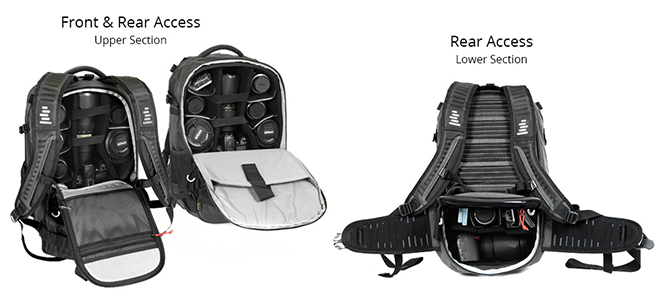
Uinta has many options. Photographers never face the same conditions and what works best in the morning may not work in the evening. With the Multi-Point Front and Rear Access System you have the ultimate control on how you would like to access your gear. When Modules are installed in the top section of the pack you have full access to your gear from either the back or front of the Uinta. And the Small Pro Module (when installed in the lower section) is easily accessed through a third opening on the bottom back of the bag. Uinta even has built in room for up to a 17″ laptop and compartments to organize the small stuff in life.

Introductory Offer

I am currently field testing the Uinta system – look for my full review in the coming weeks. In the meantime Gura Gear have a super introductory offer for those of you keen to get your hands on the new system. When you order a Uinta with both the Small Pro and Medium Pro Modules you will receive a free Tripod & Hydration System (THS) valued at $39.95. Add a Uinta + Sm and Md Modules + THS to your cart. Use coupon code FREETHS when checking out.

Creating Intimate Wildlife Photographs

Arctic, News and Updates, Photographs, Travel Photography, Wildlife Photographs

One of the easiest things you can do to dramatically improve your wildlife photography is to get down low. Chris Gamel who was a participant on my photography expedition to Antarctica last November touched on this briefly with his ‘Alter the Perspective‘ tip in his guest post here on my blog a week or so ago. It is worth emphasising the importance of this advice as getting down low allows the photographer to connect with the subject and create a far more intimate photograph than one taken at the average human standing height. When you get down low (to eye level) with the wildlife you have a much better chance to connect with your subject and to create a photograph that tells the viewer much more about the life of the critter and the environment in which it lives. Many banal wildlife images could easily have been improved if the photographer had made the effort to get down to the perspective of the subject. Getting down low is not always the answer of course. There are occasions when raising the perspective is the preferred approach and these instances should be relatively obvious.

I am including an example below that illustrate the importance of getting down low and connecting with your subject in wildlife photography. I want to place particular emphasis on ‘connecting with the subject’ as this is something professional portrait and street photographers often talk about and with good reason. When you connect with your subject you have a far better chance to successfully capture their character and personality. You are going to create a photograph that tells the viewer something about the subject and perhaps gives an insight into who they are.  Connecting with a subject does not always mean you have to make eye contact either. Connecting in this case simply means you are shooting the subject in a manner in which you are trying to tell their story. When it comes to telling the story of wildlife my preference is often to shoot landscape photographs that include wildlife rather than head and shoulder portraits. Photographs that include the animal in the landscape tell the viewer something about the environment in which the animal lives and helps place the critter in context. In this example I am including a photograph that is more portrait orientated to better illustrate the importance of perspective. I photographed this Polar Bear at 80º North of Svalbard at the edge of the permanent pack ice. This bear showed no fear whatsoever of the small ship (with only twelve photographers aboard) I was travelling on and approached within just a few feet of us. The opportunity to create a great photograph was a combination of being in the right place at the right time, but just as important as actually being there was getting down low. In this instance I got down as low as I possibly could and waited until such time as the bear and I made eye contact before I pressed the shutter and took the photograph. The result is an intimate and personal photograph that speaks volumes about the environment in which the animal lives and how it perceives its surroundings. The viewer perceives the sea ice and surroundings from the perspective of the bear which helps connect the viewer with the subject. In this instance, eye contact with the bear helps draw the viewer into the photograph and emphasises the connection with the subject.

I want to emphasise that getting down low and connecting with your subject starts long before you arrive on the scene and take a photograph. You have to consider the location you are going to be shooting from and how this relates to where your subject might be when you press the shutter. And of course you have to take into account the all important background amongst a myriad of other technical, aesthetic and compositional concerns and challenges.  Some forward planning can go a long way when you are planning your next wildlife photography sojourn. Give serious consideration to the places you will be able to take photographs from and the opportunities that location will provide you. Your chance to get down low and connect with wildlife could be more than hampered by a poor choice of vessel or vehicle. Large cruise ships with hundreds of people and big buses that place the photographer high up are not ideal shooting platforms if you want to get down to eye level with your subject. Be it an African Big Cat Safari or an expedition to Photograph Polar Bears take a moment and find out what your real options are for connecting with your subject. It could well be the difference between an outstanding wildlife image and just another snapshot.

Limited Edition Gura Gear Bataflae 32L Camera Bag in Stone Green

Equipment, News and Updates

The good folks over at Gura Gear who design and manufacture my favourite camera bags have just announced a new limited edition Stone Green version of the Batalfae 32L (The Bataflae 32L is my primary camera bag for international airline travel, workshops and expeditions. I usually just order my camera bags in black, but there is some real benefit to having a limited edition colour when you are reaching for your camera bag on a trip or expedition amongst a myriad of other ‘black’ camera bags. Stone Green was inspired by Gura Gear’s recent work in the field and will be available exclusively in the Bataflae 32L beginning in Mid-January 2014. The limited edition Grey and Tan colors of the Bataflae 32L were discontinued last fall. There are still limited quantities remaining of the Tan Bataflae 32L (Grey is sold out). You can Pre-order the new Stone Green today to receive it in the first shipment later this month. If you are wondering just how much gear you can actually fit inside one of these Bataflae 32L bags be sure to check out the VIDEO I did late last year.

Iceland Elves and Roadwork Delays…

Media

Ok -This is not a photography related post by any means (you are just going to have to forgive me this once). But, this news does pertain to my favourite country in the world and therefore I just could not resist sharing this article that appeared in the World Correspondents section of the Australian Age Newspaper on December 24th last year. I can’t say I have seen any Elves in my many visits to Iceland, but having experienced Iceland’s fantastical and primordial landscape you can count me amongst the believers. Any country that has the thirteen trolls of Christmas including one named Stubby who eats the crusts left in pans gets my nod of approval. Bless them all. Just click the image for a larger easier to read version.

Testimonial from Sam Krisch – Antarctica 2013

News and Updates, Testimonials

In 2013 I traveled twice with Joshua Holko and Daniel Bergmann: To Iceland and to Antarctica. I am a veteran of many photography tours and workshops. I have experienced both the best–and the not-so-best–of trip leaders and instructors.

Joshua and Daniel do their utmost to make sure that all of the participants have the best photographic experience. They are always available for questions and help for those that need it. They have the sensitivity to enable those participants who do not like or prefer instruction to get the maximum image-making opportunities.

While they are exceptional, inspirational photographers themselves, they always put their own work on location on hold for others. I will be glad to travel with them again and highly recommend that others enjoy the high quality tours they operate. I would rank them as two of the best anywhere. Sam Krisch – www.samkrisch.com

Guest Photographer: Chris Gamel – Better Wildlife Photography

Guest Photographer, News and Updates

I am kicking off a new segment on my blog in 2014 for guest photographers with whom I have travelled before to share some of their own writing and photography. The first to do so is wildlife photographer and biologist Chris Gamel. Chris accompanied me late last year on my expedition to Antarctica is an accomplished wildlife photographer in his own right. Today he shares five useful tips for better wildlife imagery.

Better Wildlife Photography

I want to begin by thanking Josh for letting me write this guest blog post.  I have learned quite a bit from Josh and I appreciate the opportunity to give something back. This past November, I joined Josh on his Antarctica photo tour.  As would be expected, the photographic opportunities were amazing.  Our days were filled with giant icebergs, playful penguins, slumbering seals, and dramatic landscapes.  Interestingly, one of the most rewarding aspects of attending such a tour is the opportunity to interact and share with other photographers. Over time, photographers tend to develop niches, specialising in a particular type of photography.  Each is an expert in his or her own niche, and serve as a ready source of information about that niche.  Attending a photographic tour provides a wonderful opportunity to plug into that expertise and improve your own photography. Despite the benefits, not everyone is able to attend a photographic tour.  In the spirit of photographic tours everywhere, I would like to share some tips that you can use to improve your wildlife photography.

Tip #1: Alter the PerspectiveWe spend most of our lives viewing the world from five and a half feet (more or less).  It is what we see every day, and after the first few years that view begins to lose its charm. Show your viewers something different!  Challenge their perspective!  Climb up a tree, crawl through the mud, or simply kneel down to capture a penguin’s view of the world.  With that in mind, a good rule of thumb for photographing living creatures is to capture the image from the subject’s eye level.  If the subject is shorter than you, drop down.  If it is taller than you, find a way to get higher. Take the penguin image above as an example.  It was the first penguin I photographed in Antarctica and I took it while lying on my stomach in the snow.  The low angle provides a different perspective then is usually seen and it helps to emphasise just how large these birds are.

Tip #2: Eliminate DistractionsToo often we try to include too much in our images.  Amazing events are unfolding in front of us and we want to capture everything.  The problem is that while our eyes are great at ignoring visual distractions, our cameras are terrible at it.  To greatly improve your images, try this little trick.  Ask yourself what you are taking a picture of.  The fewer words you use to answer that question, the better.  Once you have identified your subject, fill the frame with it.  This might mean getting closer, or using a longer lens. For example, look at the penguin image above.  The subject can be easily summarised: “jumping penguin.”  Once that subject was clearly identified, I did everything possible to remove any distracting elements.  The only things included in the frame are the jumping penguin and the ice it is jumping on.  The result is a clean image showcasing an animal’s behaviour.

Tip #3: Get the Eye in FocusWhen photographing wildlife, what part of the animal should be in focus?  The obvious answer is all of it, but that’s not always realistic.  Long telephoto lenses produce a very shallow depth of field and there are times when either equipment limitations or creative choices means only part of your subject will be in focus. The general guideline when dealing with wildlife and select focus is to make sure the animal’s eyes are in focus.  If only one eye can be in focus, focus on whichever eye is closer.  As long as the eyes are sharp, the viewers will accept that the image is sharp.  This is true even if other parts of the image are out of focus.  If the eyes are out of focus, the perception will be that the entire image is out of focus.

Tip #4: Watch the BackgroundBackgrounds can make or break an image.  As wildlife photographers, we often get so excited about the subject in front of us that we forget to consider the background.  Sometimes an image calls for a clean background.  Other times, the background will contain elements that complement the subject.  When composing the image, slow down and look at each element of the image, including the background.  Ask yourself these questions.  Does the current background add or detract from the image?  Will moving the camera help to improve the background?  Will a different lens produce a different result? The image above is an example of a simply, clean background.  During a landing in Antarctica, I observed penguins walking through a ray of sunlight as the crossed a small ridge.  The warmth of the golden sunlight created a beautiful contrast against the blue wall of ice behind the ridge.  By moving a few feet to my left and dropping onto my stomach, I was able to remove all distracting elements from the background.

Tip #5: Wait for the BehavioursOne of the joys of wildlife photography is that you never know exactly what your subject is going to do.  Sure, a knowledge of animal behaviour helps, but if you want to capture images of animal behaviour, you have to use the most important tool in your toolkit: patience. Wildlife animals don’t perform on command.  They rarely do what you expect, and if you want to capture behaviours you need to be ready to press the shutter at a moment’s notice.  I regularly sit and watch wildlife through my lens with my hand on the camera’s shutter button.  I might have to wait for minutes to hours, but when the action starts, I am ready. The image above demonstrates the rewards that come from patiently waiting for animal behaviour.  By composing the image and waiting, I was able to capture this brief moment in time when the penguins looked up at the full moon. While this post is not a comprehensive introduction to wildlife photography, my hope is that these tips will provide a little guidance the next time you try your hand at wildlife photography.

Chris Gamel is a storyteller who combines photography and filmmaking to tell stories about the natural world. His wildlife research and award-winning photography has taken him to all seven continents as he shares the beauty and biology of the natural world.  To see more of Chris’s wildlife images, and to learn more about wildlife photography and filmmaking, visit his website at http://www.ChrisGamel.com.  Sign up for his free newsletter and receive a free copy of Transitions: 10 Tips for Transitioning from Photography to Video.

Better Photography Magazine – The Jewels of the Arctic Report by Peter Eastway

Arctic, Media, News and Updates, Travel Photography, Workshops and Expeditions

One of the real pleasures of 2013 for me was having Grand Master of Photography Peter Eastway co-lead the Jewels of the Arctic expedition last August to Greenland and Svalbard. Peter is one of the most accomplished, awarded and respected landscape photographers working today and it was fantastic to be able to work with him during this expedition. On top of being a landscape photographer Peter is also owner and editor of Australia’s Better Photography Magazine. He recently documented our journey through the Arctic for the Summer 2014 issue and has generously allowed me to release the article here as a PDF for download. Be sure to visit Better Photography and subscribe for future articles and issues.Just in case you missed it – Be sure to watch the short film produced by my good friends at Untitled Film Works of our experiences in the Arctic. Make sure you watch it full screen in glorious 1080p High Definition!

For those of you who have already enquired about the expedition I will be leading in July 2015 to Photograph Polar Bears I will be opening bookings in the next few days. This expedition will be limited to just twelve photographers and there are preliminary details on my website in the WORKSHOPS section.