Book Review: Life at the Edge by Carsten Egevang

Book, Book Reviews, News and Updates, Reviews

Photography books are one of my greatest joys and passions and so it is with great enthusiasm I am reviewing Life at the Edge by Carsten Egevang. If you are unfamiliar with Carsten’s work I encourage you to run (not walk) to his website and spend some time pouring over his remarkable photography. A Danish photographer and a professional researcher with more than twenty years field experience in Greenland, Carsten clearly has Greenland and the Arctic in his heart. Carsten has been recognised in several international photo competitions, including category winner in the BBC Wildlife Photographer of the Year – the highest position a Dane has yet been awarded in this prestigious competition. He was also awarded the title of “Danish Nature Photographer” (2011) and was a recipient of the Greenland Government’s “Environment and Nature Prize” (2012). Carsten is also a member of the Arctic Arts team (of which I am also a member). He is a master documentary photographer and his book Life at the Edge is a wonderful documentary account of the fragility of life in Scoresby in the Arctic.

The inhabitants of Scoresby truly lives LIFE ON THE EDGE. The settlement represents the edge of where to find human habitation in the sparsely populated eastern Greenland. Nearest inhabited area are 800 km to the south and north of Scoresby the world’s largest national park is found. At the same time the inhabitants of the isolated Scoresby lives on the edge of livelihood. Supplies from the outside world to the city are extremely sparse, and traditional fishing shall form a larger role than most other places in Greenland.

Life at the Edge documents Carsten’s travels to Greenland with his camera to shoot wildlife and to document the traditional Inuit way of life as it unfolds in modern Greenland. Although Life at the Edge is a collection of black and white photographs only; it should be noted that Carsten also shoots colour and has released other books with colour images.forside-life-at-the-edge-carsten-egevang-thumb1Presentation – Hardbound on a soft and supple lustre paper  Life at the Edge  is a sizeable publication; consisting of more than 200 pages.  Presented in multiple languages (including English) I found the layout of Life at the Edge to be highly complimentary to the documentary style of photographs. Divided into chapters, or sections there is introductory text for each section and explanatory text and notes are further scattered throughout the book.  I found the introductory text really helped set the stage and greatly enhanced my appreciation for the photographs.

The choice of photograph for the cover is complimentary to the photographs inside and the entire book is a very well constructed package of excellent quality.

The majority of the photographs are framed by the white of the paper in Life at the Edge and this works exceptionally well to contain the imagery from page to page. Full bleed images are scattered throughout the book and these do help to break up the book. I particularly enjoyed the layout of this book and the use of small photographs on some of the pages to create a greater level of intimacy. In an era where big is often seen as better it is nice to see the use of small images employed to help draw the viewer into this mystical polar world. As I have written before, this technique is highly effective at viewer engagement and more photographers would do well to take notice. Presenting a 200+ page book of photographs that continually engages the viewer is extraordinarily difficult and most books of this size leave me tired well before I get to the last pages. The simple reality is that there are only so many photographs my brain can absorb in a single sitting before the images start to blend together. Like Vincent Munier’s Artique (reviewed HERELife at the Edge transcended this limitation for me and left me wanting more. That is an extraordinary accomplishment.

You can watch a short film about Life at the Edgby clicking on the image below:LifeattheEdgeFilmPrint Quality – Life at the Edge is the first photography book I have reviewed that comprises entirely black and white photography. Black and white photography books (perhaps even more so than colour books) live and die by the quality of the printing. If the blacks are washed out and muddy, or of the highlights are blown out, or tonality is lost then the impact of the images is greatly impacted. The photographs in Life at the Edgcould so easily have become poor muddy facsimiles of the originals if the printing were not delicately handled. The eye takes great pleasure in the subtle tonalities of superb black and white printing and I am very pleased to say that the print quality throughout Life at the Edge is really superb with really deep solid blacks, wonderful shadow detail, sublime tonalities and highlights and an excellent dynamic range.

Conclusion –Life at the Edge is a superb documentary collection of powerful photographs that tells the story of life in the Arctic. The choice of photographs work very well as a collective body of work and are very effective in documenting modern life in the Arctic.

I strongly recommend you consider adding Life at the Edge to your collection of photography books. If you have ever travelled to Greenland and experienced the Arctic then you will no doubt connect with Life at the Edge on a very deep level. If not, then Life at the Edge will give you new insight into this incredible part of the world.  Life at the Edge is a must have addition to your  photographic library and can be purchased online for 50 Euro plus shipping.. Highly recommended.

Overall Review –***** Must Own. No photography library is complete without this book.

Arctic Arts Presents at Arctic Circle Assembly in Reykjavik Iceland

Arctic, Media, News and Updates, Travel Photography, Video

The Arctic Arts Project of which I am a project photographer is in final preparation for The Arctic Circle assembly in Reykjavik, Iceland, where we will be co-presenting with Institute of Arctic and Alpine Research, Earth Vision Institute and Stefansson Institute. With Photographers: Kerry Koepping, Örvar A. Þorgeirsson, Joshua Holko, Iurie Belegurschi, Carsten Egevang, Andy Williams and Marc Muench. Unfortunately, I will be unable to attend in person due to my other travel commitments. However, I can share a preview of the video we will be showing at the Assembly. Just click on the image below. Read more about the Arctic Circle Assembly HERE.ArcticArts

Polar Photography Presentation Community College of Rhode Island

Antarctica, Arctic, Media, News and Updates, Travel Photography, Uncategorized

PhotoPlus in New York is now only around the corner (I will be leaving Australia in just over a week). As well as presenting at the Moab, and Legion Paper, BenQ and Canon stands I will also be giving a free Polar Photography presentation at the Rhode Island Community College  on Thursday October 27th between 6 and 8pm. Details Below:14466995_10210904338992494_1634388334_o

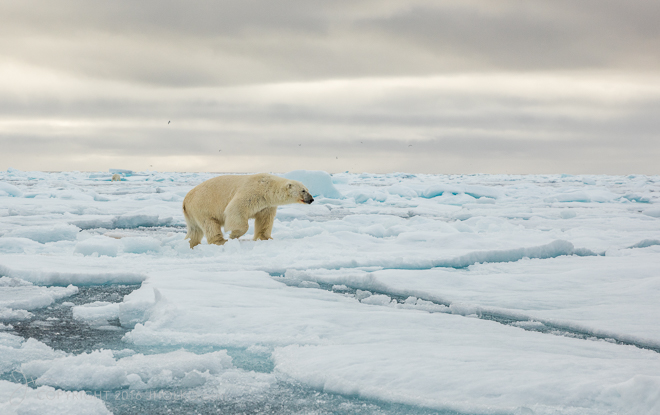
Photo of the Month October 2016 – Polar Bear on Sea Ice

Arctic, Media, News and Updates, Photographs, Travel Photography, Wildlife Photographs

The photograph of the month for October 2016 was taken on my Polar Bear expedition to Svalbard this July (read the trip report). I actually made this photograph through the open porthole of my cabin as I wanted to be as low down to the water as possible (wildlife photographs are almost always stronger and more powerful when you get down to eye level with the subject).  I had been photographing the bear from the deck of the ship with a 600mm lens. When he started to approach closer to the ship I grabbed a wide angle lens and ran downstairs to my cabin as I new there would be an opportunity to capture a dramatic image of the bear in the landscape from a low perspective.  We were fortunate to have some really dramatic cloud and lovely soft arctic light under the midnight sun. Svalbard2016-5843-EditIf you are interested in photographing Polar Bears on sea ice under the midnight sun there are now only a couple of places remaining before my expedition next July will be sold out.  You can register your interest by dropping me an email.

One of my very good friends and Norwegian partners Ole Jorgen Liodden has just launched a new project and study on Polar Bears vs. Humans.

Polar bears and humans have a long history in most parts of the Arctic. Since the Inuitts met the Polar bears thousands of years ago, there has been more and more interaction with this large predator. Hunting, scientific activity and tourism is today directly interacting with the Polar bears, and also climate change and pollution can be linked to human activities, affecting the life of the Arctic King.

The big question is how this human activity is affecting the Polar bears. How many Polar bears are killed annually? Is this hunting sustainable? Is the Polar bear management effective? How does the climate change affect the survival and opportunities for Polar bears? Is the population of Polar bears decreasing or increasing? Are there any red flags regarding the trade of Polar bear skins? These are some of the important questions very few authors, researchers or organizations are asking. In this project we want to publish information about these topics and ask the questions to different Polar beard interest groups.

The project aims to expose the impact of Polar Bear trophy hunting as well as the legal and illegal hunting and killing of Polar Bears in the Arctic. You can read more (and support) about this important project on the project website.

Landscape Photography Magazine – Raw and Unedited Interview

Media, News and Updates, Travel Photography

Landscape Photography Magazine have just published a new Really Right Stuff Sponsored Interview in their latest (no. #68) October issue. The interview was a great opportunity to talk a little bit about how I transitioned into a full time professional Nature Photographer and also my own ethics and thoughts on Nature Photography. Interview Excerpt Below:

In your opinion, how vital is integrity in the field of landscape photography?

Integrity is critical if we are to be honest with the viewers and honest with ourselves. When we look at a photograph we expect – or at least hope – it is real and not a digital creation. I personally believe in rewarding the skill of the photographer in the field and not the skill of the retoucher in front of a computer. Nowadays, literally anything is possible with digital manipulation in post-production. Multi-image composites are commonplace and are frequently presented to the viewer – often through social media – as ‘captures of nature’. Whilst it is fine to do this sort of manipulation I find it disingenuous not to disclose it. Nature photography should be about capturing what we find in the field, and not creating it on a computer. The latter is digital art in my book.

When I see images that are clearly composites being used to market workshops to exotic locations, that really irks me. Participants on those trips are going to expect to see that scene and are unaware that it is a fabrication. Our integrity as photographers is all we have to stand behind. That’s not something I wish to compromise.

The full interview is available for free on the Landscape Photography Magazine website.RRS-Interview

Canon 600mm F4L IS DO Lens in Development

Equipment, News and Updates

Camera and lens rumours don’t often make news on my blog; but I wan to make an exception in this case as I believe the development of the Canon 600mm F4L IS DO lens will be a real game changer and one of the most exciting lenses to be expected in recent times. A 600mm F4 DO lens will absolutely change the game for wildlife photographers who (wedded to the sublime bokeh of 600mm F4 lenses) have traditionally had to schlep large, bulky and heavy telephoto lenses around the globe in search of wildlife. As a photographer who regularly travels with a 600mm F4L IS MKII lens I can tell you that its no easy task getting such a large piece of glass on location on the the other side of the world. A 600mm F4L IS DO lens would be manna from heaven. I think I’ll make some space for this one in my lens cupboard now….

From Canon Rumours

We’re told that the Canon EF 600mm f/4 DO IS that was shown in prototype form at Canon EXPO in September of 2015 is currently scheduled to be launched in the second half of 2017.canon600do-728x403


Iceland the Highlands Workshop Reports 2016

Iceland, Landscape Photographs, News and Updates, Photographs, Travel Photography, Workshops and Expeditions

In August and September of 2016 Daniel Bergmann and I lead two back-to-back workshops into the spectacular Highlands of Iceland. The first of these two workshops focused on the Highlands and northern areas of Iceland and the second on the Highlands and Southern region. We chose late August and September for our workshops due to the large increase in tourism in recent times in Iceland during the summer period. In truth, tourism is actually out of control now in Iceland and you absolutely must get off the beaten track if you want to get solitude in the wilderness. Part of our planning was to spend a large portion of our time in the more remote areas of the highlands in order to make sure we were well away from the masses.  This proved most fruitful with spectacular landscape free from throngs of tourists._MG_6396-EditAs many of you know who follow my blog, the highlands are in my opinion the real jewel in the crown of Iceland. The area offers incredible photographic opportunities and is in comparison to the rest of the island rarely visited by tourists. The Highlands of Iceland actually cover most of the island’s interior. Inaccessible in winter, they rise 400–500 meters above sea level and are an untamed mingling of uninhabitable volcanic desert, jagged mountains, glaciers and hot springs. A few oasis like areas, such as Herðubreiðarlindir near Askja, are found only in proximity to rivers. From a first time photographers perspective the highlands can be a challenging location to work and photograph. Some walking and hiking is really required to get the best compositions and the area is subject to highly variable weather. All of this makes for really interesting photographs that in my opinion are far more evocative than the usual sort of cliché images from Iceland that seem to dominate social media today (more on this later).

We began our workshops with an early departure on the 14th of August and drove to our Hrauneyjar highland base, where we were located for three nights. From Hrauneyjar we explored the magnificent Fjallabak Nature Reserve, which included the Landmannalaugar area and other lesser known highland pearls, such as the Veidivotn region (one of my absolute favourite locations in Iceland). Exploring and photographing the highlands of Iceland from super jeep we were able to stop when we wished and take full advantage of weather and light as conditions permitted. It also meant we were able to take the most rugged and remote mountain passes and really explore the best of the highlands. The weather is highly variable in the highlands and we did experience everything from sunshine to pouring rain and fog during our stay in this area. Although this sort of weather can prove challenging, I personally find these conditions the most interesting to work and photograph in._MG_6397-EditOn August 17th we traveled across the Sprengisandur route that crosses the interior of the island and found our way to Lake Myvatn in the north, where we spent the next three nights. The Sprengisandur route took us right up the middle of the island through some of the most desolate lunar landscape to be found anywhere on earth. We photographed the waterfalls of the Skjalfandi river (Godafoss and Aldeyjarfoss), plus Dettifoss and Selfoss waterfalls in the Jokulsa river. We also explored the geothermal areas close to Myvatn. The geothermals of Myvatn continue to provide unlimited opportunities for photography and remain one of my favourite areas to visit and photograph in the north. This area is extremely dynamic and is in a constant state of flux. The landscape is alive with mud pits and fumoroles and steaming sulphur creates an otherworldly landscape. At sunrise and sunset we had the entire area to ourselves and some fabulous images were created.IcelandHighlands2016-6243Once we had concluded our stay at Myvatn we travelled west along the northern coast and overnighted near the Vatnsnes Peninsula. Hvitserkur sea stack was one of our main subjects at Vatnsnes, along with other coastal features. The following day we travelled to the Snaefellsnes Peninsula, where we spent the last two days of our trip. At Snaefellsnes we photographed the iconic Kirkjufell mountain and the spectacular coast at Arnarstapi and Hellnar, on the southern tip of the peninsula. We concluded our trip on the 23rd of August at Keflavik international airport.

IcelandHighlands2016-6168 Our second workshop commenced early in the morning on the 28th of August with a drive to the Kjolur highland route towards Kerlingarfjoll mountains, where stayed overnight in mountain cabins. Our main photographic objective was the incredible Hveradalir geothermal valleys, above our lodging. We photographed the area at both sunset and shortly after sunrise and some really unique images resulted from our time in this area. This was actually only the second time I had visited this area of Iceland and it did not fail to disappoint. The geothermals in this area are extremely active and the entire landscape is alive with sulphurous fumaroles and boiling mud pots. It would be easy to spend a week in this area just exploring and photographing the many features to be found. The area is (thankfully) not on most tourists radar and as such is usually frequented only by hikers and campers. _MG_6290-EditAfter our stay at Kerlingarfjoll we drove to the Hrauneyjar highland base, where we were located for three nights. From Hrauneyjar we again explored the magnificent Fjallabak Nature Reserve. The weather proved fickle during our time in this area and we again had a real mix of rain and sunshine. 

On September 1st we travelled across the highlands on our way south. It was a day of travel through some of the most incredible landscape in Iceland. We were blessed with some really dramatic cloud and light and some fabulous photography resulted from our journey through this remote part of Iceland._MG_6453-EditOnce out of the highlands we overnighted at the town of Hella before traveling further east along the coast to the Vatnajokull region, where we stayed at Gerdi for three nights. Once at Gerdi we were in the proximity of the Jokulsarlon glacial lagoon and the many outlet glaciers from the Vatnajokull ice cap. This was our grounds to explore for the coming days and we photographed at the black sand beach, the glacial lagoon, Stokksness as well as several other lesser known locations off the tourist radar. After our stay in the southeast we traveled back west and spent a night on the southern coast. On our departure day we headed off towards the Keflavik airport._MG_6697With tourism increasing exponentially in Iceland in recent times it was ideal timing for us to get up into the Highlands on both these workshops and find solitude and peace in the wilderness. Until tourism tapers off in Iceland I will be unlikely to run future landscape trips in the peak summer season (June, July and August) as it has just become far too crowded for serious photography at many of Iceland’s best known natural attractions. Instead, I will be focusing on more remote winter trips and more specialised workshops (such as the Puffin workshop next year) that take us into more remote wilderness locations, well away from the tourist crowds.

New Zealand South Island Masterclass 2017 Sold Out

Landscape Photographs, New Zealand, News and Updates, Travel Photography, Uncategorized, Workshops and Expeditions

I had been planning for some time to formally announce my New Zealand South Island Masterclass workshop for next year (2017) here on my blog; but realised yesterday the trip is actually already sold out. _MG_5661If you are interested in travelling to New Zealand and photographing in the spectacular South Island you can still register your interest to be put onto the wait list. Like the 2015, and 2016 workshops, the 2017 Masterclass workshop also includes extensive use of helicopters for accessing some of the most remote and spectacular country as well as aerial photography of the spectacular Southern Alps and glaciers. Full details of the workshop are available on my website as a PDF HERE.

NewZealand-1988I will be announcing dates soon for the 2018 New Zealand South Island Masterclass. If you would like to get the jump and be one of the first to be notified when dates are confirmed you can register your interest now by dropping me an email. No obligation at this point. You can read a trip report from the 2016 Masterclass HERE.

CamFi Remote Camera Controller Product Review

Equipment, News and Updates, Reviews

Over the last couple of years I have been investigating different options for remotely triggering cameras for wildlife photography (mostly for my project with the Arctic Fox). One of the solutions I settled on after much research was the Camptraptions camera trap system which I reviewed here (Read the REVIEW) some months ago now (and have subsequently used to photograph Arctic Fox). More recently I came across an alternate (but different) solution from a company called CamFi that utilises a smart phone for remote camera control. Now, I know that smart phone control of a DSLR is nothing new. There are a number of different products on the market that offer varying levels of camera control from smart devices. Just being totally upfront, I have historically not really been a fan of camera control from smart phones. Mostly because I find it cumbersome to use a smart phone in the sort of cold weather environments I am often shooting (plus iPhone battery life in the cold is really appalling). However, the CamFi system is so feature rich and the control is so slick that I believe the system could work reasonably well even in quite hostile conditions.  Of course, much depends on your smart phone device in these sort of environments. So with the Caveat that I have not as yet had a chance to test this in either the Arctic or Antarctica you can read on…camfiCamFi is at its most basic, a way for photographers to control their Nikon or Canon DSLR wirelessly. The list of cameras supported by CamFi is steadily growing and a complete list of currently supported cameras can be found on CamFi’s website HERE). The device mounts on the hot shoe of compatible DSLRs and creates a Wi-Fi network that you can connect to using a PC or Mac as well as Android and iOS mobile devices. The wifi network created by the CamFi trigger is by default unsecured and open (it needs to be so you can connect to it). Once you have connected to the device from your phone you can access the settings in the application and quickly and easily secure the network. Anyone using the device in dense urban areas should probably keep this in mind and secure the network as a first order of business. Wireless range is more than reasonable and will I imagine be more than sufficient for the majority of applications.CamFi_sliderWith dedicated apps CamFi will allow for Live View on a mobile device, as well as capturing images and controlling camera settings such as AF points, metering mode, exposure compensation, aperture, shutter speed and ISO (so it can do a lot more than a pair of pocket wizards for example). You can also configure CamFi to automatically display images as they are taken and connect to an Amazon Fire Stick for viewing on TV sets (a bit gimmicky, but might be of use in a studio environment). Additionally you can browse, delete and view images, including EXIF data on your camera from your mobile device or computer, and a robust built-in time-lapse feature is included. I wont go into detail on every feature of the CamFi as that would require a lot of explanation. Suffice to say, there are some explanatory videos on the CamFi website that outline the many features of the product and these are worth investing some time in if you have an interest in remote control of your DSLR Camera.1-bigscreenAccording to the manufacturer, CamFi has a six hour battery life. In my own initial testing I found battery life to be +/- an hour or so from manufactures specified time. I suspect battery life in cold environments to be radically reduced (although I have not as yet had time or the opportunity to test this). I suspect battery life is also going to be heavily dependant on how much you are using the device; but I have not really had time to do extensive testing to date. Given the size of the device and the requirement for it to create and communicate via a wireless network I find the battery life to be more than acceptable.

In my testing with the Canon EOS 1DX MKII and EOS 5DSR to date I have found the CamFi to be simple, responsive and intuitive to use. One might gripe that the unit that mounts on the hot shoe is bigger than it needs to be; but it would be a quibble and given the unit weighs almost nothing I don’t find the size objectionable (its not much larger than a Pocket Wizard). The unit is charged via a micro usb port and so can be plugged into any computer to charge. The CamFi is supplied with a cable appropriate to your camera at time of order and the unit itself also includes a LAN Port (LAN cable not included).

The application to control CamFi  is also available for the Mac / PC. So you can control the camera from a computer as well as from a smart phone. The Camfi software is compatible with devices and computers running at least iOS 7.0, Android 4.0, Windows XP or Mac OS X 10.10.  CamFi is currently listed at $130 USD on Amazon and at this price is well below manufacturer-provided options for high-end DSLRs. I find it cheap for the features and functionality it offers.

Conclusion: I have to admit that when I first received the CamFi I thought it was a bit of a gimmick and not really a serious tool for photography. However, the application offers just about every level of control you could possibly want from your camera (even live view!) and is simple and easy to operate. In real world use the software is slick, robust and quick to use. There really isn’t much to dislike about the product and I expect it will prove useful in a number of different circumstances. I can envisage a situation where I might use it to photograph Aurora Borealis at night from the comfort and warmth of my vehicle. Simply set up the camera, retreat to the warmth of the vehicle and do the rest from inside the truck!

There are a few things I would like to see in a future generation of the product. First and foremost it would be beneficial to have a battery indicator to show how much charge is remaining in the CamFi.  I would also like to see the product incorporate some robust weather sealing for use in hostile environments and inclement weather. As it currently stands, the LAN port and USB ports are fully exposed, so I am not sure I would be comfortable using this device in pouring rain.

I would also very much like the ability to see a live histogram on the controlling device before I take a photograph (this feature is currently missing). You can see a full RGB histogram after you take a photograph (along with all other relevant metadata) so the lack of live histogram isn’t exactly a deal breaker; it would just be nice to have.

Summing up, CamFi is a pretty cool hardware and software system that enables remote WiFi control of many Canon and Nikon DSLR models. The CamFi iPhone App has a better interface and is more feature rich than the Canon and Nikon equivalent software. Critically, it allows you to change exposure settings as well as other key camera settings like ISO and metering. For the many DSLRs that do not have WiFi capability, it could be an important tool for remote shooting and quickly sharing photos to social media. In my own photography it will no doubt find various uses as I continue to experiment with the device.

Polar Bears of Svalbard 2016 Expedition Report

Arctic, Landscape Photographs, Media, News and Updates, Photographs, Travel Photography, Wildlife Photographs, Workshops and Expeditions

In late July 2016 I lead my annual Polar Bears of Svalbard photographic expedition to the edge of the permanent pack ice north of Svalbard to photograph Polar Bears living and hunting in their natural environment. During the expedition we also photographed incredible arctic landscapes as well as other wildlife of the Arctic region including Walrus, Arctic Fox, Whales, Seals and a plethora of sea birds including the rare Ivory Gull (the rare Ross’s Gull remains an elusive species for me in Svalbard). This expedition was for a small group of just twelve passionate photographers and utilised a small ice hardened ship that enabled us to sail north directly into the pack ice in search of the king of the Arctic.Svalbard2016-5959-EditImportantly, our ship had very low decks that were very close the waterline which enabled us to make photographs at eye level for more intimate images. The choice of ship for expeditions such as these is critical to the ability to put yourself in the best possible place to make powerful and emotive photographs. Large ships that are unable to penetrate the ice and with high decks  where you have to compete for space with other passengers are far from ideal and unsuited to photography expeditions. During the expedition we were fortunate to see and photograph an incredible twenty Polar Bears in the just the first three days! Two of these bears were also on recent seal kills. Seeing a Polar Bear on a seal kill is a very rare event and as luck would have it were able to photograph the kills and all aboard were able to capture some really fantastic photographs. What was even more special was the even rarer encounter we had with a mother and her 6 month old cub on the sea ice. This was truly a special moment with a very curious cub and a very calm mother we were able to approach very close in our zodiacs for some really superb photography. As one participant put it “It was two hours photography that was better than his previous six visits to Churchill National ParkSvalbard2016-24158This year we undertook a different route to my 2015 expedition and instead of heading south and circumnavigating Spitzbergen we headed directly north for the pack ice. This turned out to be the perfect decision with twenty polar bear encounters in the first three days in the ice. The Arctic pack ice is a vast area and just finding Polar Bears in this maze of ice can be quite the challenge. Encountering so many bears in such a short space of time was truly miraculous.Svalbard2016-5843-EditAfter three days in the ice we continued our northerly travels encountering light to moderate winds in the Hinlopen strait. In this area we explored and photographed the spectacular 200 mile+ long glacier face Bråsvellbreen and the plunging bird cliffs at Kapp Fanshawe. The sights and sounds of thousands of nesting birds against such a precipitous cliff is an awe inspiring sight. I have been fortunate to visit this area a number of times now and it never ceases to impress. Being surrounded by thousands of Arctic birds is a very special experience.  Svalbard2016-12283-EditWhen it was time to head south again we made several stops in the spectacular Kongsfjorden; where we photographed Arctic Fox and spectacular glacial fronts. We rose very early one morning for a wonderful session photographing Walrus in fantastic light. During the expedition we were also fortunate to see and photograph several rare Blue whales (unfortunately I did not get a good photograph). Blue whales are quite tricky to photograph as they rarely reveal to much of their body above the waterline. Nevertheless the experience of seeing this massive mammal is an experience that stays with you forever.Svalbard-0404At our furthest northerly most position we were just shy of 82º North – less than 500 Nautical Miles from the North Pole. In total we travelled a total distance of 1148 nautical miles (2126 kilometres). Our total wildlife count for the expedition was twenty Polar Bears, two Arctic Fox, four Humpback Whales, three Blue Whales, two Beluga Whales, one Minke Whale, More than twenty Walrus and eight Reindeer. On top of this we had many different species of Arctic Birds. This was a fabulous result that netted some amazing photographs from all aboard.

During the expedition we took advantage of great light at every opportunity and often worked at night when the light was soft and ethereal. One of the most fantastic things about photography in the Arctic is the 24 hours of daylight and the extensive opportunities this provides for image making at any time of the day or night. One of the best moments for me personally was capturing a fog as it burnt off across the top of one of the glacial fronts.Svalbard2016-28772-EditThe high Arctic remains one of the most spectacular locations I have ever visited and I look forward to returning again next year when I will lead another two expeditions to the pack ice north of Svalbard – Polar Bears of Svalbard and Winter in Svalbard (Winter is already Sold out). The summer expedition will depart on the 25th of July from Longyearbyen and is dedicated to the photography of Polar Bears living and hunting on the sea ice. If you would like more information about this expedition please drop me an email at info@jholko.com. Be sure to check out the video below to experience just what this expedition is really like. There are now only a few places remaining before the expedition will be sold out.KingdomoftheiceBear