In late May next year (2017) I will be leading a brand new workshop with Daniel Bergmann that is dedicated to photography of the Atlantic Puffin and other birds of Iceland including Fulmars, Kittiwakes, Guillemots (Murres), Arctic Terns and Razorbills. Iceland is one of the best places in the world to photograph Puffins and other Arctic birds in their natural environment. We will visit a number of different locations during this workshop where we will have outstanding access to the Puffins living in burrows on the edge of sea cliffs. We have timed our 2017 workshop to ensure we are in the best locations at the best times to photograph these wonderful birds. We will have hours of golden light under the spectacular midnight sun – ideal conditions for photography of the Atlantic Puffin. This photography workshop will last for 11 days (11 nights). We will be staying in good hotels and guest houses that are functional and clean. Breakfast, lunch and dinner are all included and will generally be held at the hotels where we are staying. However, this workshop is all about photography and we will be putting in long hours in the field in order to ensure we get the best possible light for photography. We may take food and drink with us into the field to ensure we are in the right locations get the best possible light.
  Itinerary: We start in the morning of May 27th in Reykjavik City and drive out to the Snaefellsnes peninsula. We’ll photograph birds and landscapes out at the edge of Snaefellsnes at Hellnar and Arnarstapi and will visit the iconic Mt. Kirkjufell. We’ll then overnight in the town of Stykkisholmur.
The following morning we’ll take the ferry that crosses the great bay of Breidafjordur. We’ll get off in the middle of the fjord at Flatey Island where we’ll spend one night. Flatey is renowned for its birdlife and birds on the island are unusually tame. This is a great location to photograph Black Guillemots, Snow Buntings, Puffins, Arctic Terns and other common Icelandic breeding birds.
 In the morning of May 29th we’ll get back on the ferry and finish the crossing. From the ferry port at the northern side of Breidafjordur bay we have couple of hours journey to Breidavik, where we’ll be based for the next three nights. From there it’s a 12km drive out to the magnificent seabird cliff Latrabjarg. This westernmost point of Europe is the home of millions of seabirds. It rises 440m out of the sea and is 14km long. The best locations for photography are within walking distance from the car park and we’ll have Fulmars and Kittiwakes soaring through the air, Guillemots (Murres) and Razorbills sitting on the cliff but it’s for the Puffins that we have come to Latrabjarg. Nowhere else are Puffins as tame. They can be photographed at close range, even with a wide-angle lens, and the cliff faces in a perfect direction for the setting sun. The Puffins can therefore be photographed in beautiful golden light or against the setting sun, creating wonderful silhouettes. As we are fast approaching the longest day of the year we have many hours of low light in the evening and early morning.
 Closer to our accommodation in Breidavik we can venture out and photograph the birds in the area, such as Common Eider, Ringed Plover and possibly Ptarmigan. Arctic Foxes are frequently also seen in this part of the country and with luck we might find some arctic foxes to photograph during our time in this area.
 After our stay in the West Fjords we prepare for a long journey along the northern coast to the town of Dalvik. We’ll make a number of stops for photography on the way and will stay in Dalvik the night of June 1st so that we’ll be ready for the morning ferry to Grimsey Island on June 2nd. Grimsey is the northernmost inhabited Icelandic territory and the Arctic Circle runs through the island. The small island has about 85 inhabitants, is 5.3 square kilometres in size and has steep cliffs on almost every side, which makes it an ideal habitat for seabirds. During our three-day stay on the island we’ll continue to expand on our Puffin photography, now in a completely different environment that has a much larger population of Puffins than at Latrabjarg. Due to the remoteness of the island the accommodation is quite basic. The guesthouse offers comfortable full-board lodging but bathrooms are shared. Visiting Grimsey is a once in a lifetime adventure and its rich birdlife will keep us busy throughout the day and night.
 On June 5th we’ll depart Grimsey for the main land and drive back west along the scenic northern coast. We’ll overnight in Skagafjordur in the north, where we’ll have good opportunities for coastal landscapes and more of Iceland’s common birds, such as Whooper Swans. The Skagafjordur area is also known for its horse breeding and there are Icelandic horses almost everywhere.
On June 6th we’ll continue our westward journey with stops at iconic landscape locations such as Hvitserkur and Hraunfossar waterfalls. We’ll find ourselves in the town of Keflavik on the Reykjanes peninsula in the evening and will spend our last night there, close to the Kevlavik international airport. We’ll officially end our tour with dinner that evening and any flight can be taken out of Iceland on June 7th. If you are staying on in Iceland transportation will be provided for you back to the capital city of Reykjavik.
Daniel Bergmann and I will be providing extensive in the field photographic instruction throughout the workshop for all participants. We will be covering camera setup as well as techniques for how to photograph birds in their environment. In the evenings we will have informal discussions and critiques as well as post production demonstrations. This will be a very hands on workshop and it is our intention to provide very expansive instruction as required.
If you would like join us not his unique workshop you can register your interest by dropping me an email or by registering on my website at www.jholko.com Places are filled on a first come first served basis and once they are spoken for thats it.


 Watch
Watch 
 This masterclass landscape workshop was about maximising our time photographing in some of the most spectacular parts of New Zealand. Our small group size of just six photographers provided us a really small intimate group that enabled us to put in some long hours in the field in some of the most spectacular parts of the South Island. The workshop ran for 12 days (11 nights) with an optional four day extension and we stayed in good hotels which were functional and clean. We travelled by private 4-wheel drive vehicles. We utilised several primary locations as bases from which we travelled to each shooting location. We had a good mix of weather and light during the workshop and although we encountered some rain in the Fox Glacier area we were still able to maximise our opportunities with some extraordinary light and conditions. We also managed all three of our planned aerial shoots from helicopter, despite some touch and go weather. Helicopters and aerial photography really add an extra dimension to photography in New Zealand’s South Island. The ability to quickly get up into the mountains to take advantage of weather and light is a significant advantage.
 I wrote quite an extensive report on our South Island masterclass workshop last year (read the
 Another early start as we made for the North-west coast, which is completely different to the coastal scenery we had been photographing. Characterised by dramatic sea cliffs and imposing rock formations, there are also intimate lake and tidal inlet scenes so we were kept busy for the whole day in this unique location. We returned to our lodge in the evening.
 We departed early this morning for the drive back to Christchurch. This was a full day on the road and we stopped along the way to photograph forest, country and mountain scenery as we took the Lewis Pass route south. We arrived into Christchurch in the early evening and enjoy a relaxed dinner to conclude our workshop.
 ALO is designed to even out contrast by selectively adjusting areas of the image. It is by definition most useful when using flash or with backlit subjects as it can detect faces in the frame and brighten those areas to achieve a better result. In a nutshell, the aim of ALO is to provide in-camera processing that will improve the look of your images. Those of you paying attention will have already figured out that it applies to jpeg files because it is working on in camera processing.
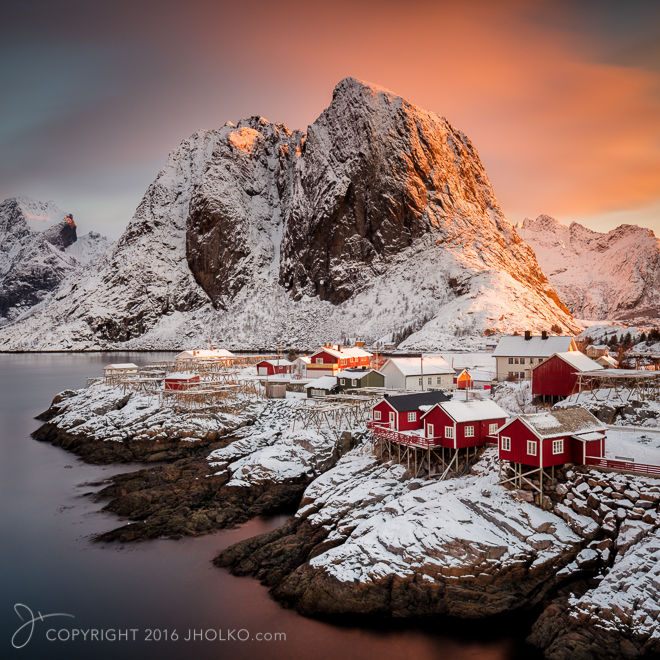 This workshop was a for a small group of just six experienced landscape and nature photographers. We based ourselves primarily in the small town of Reine and made daily excursions to various locations around the Island for photography. Lofoten has become quite the hot spot for photography in the last few years (some are calling Lofoten the new Iceland) and although we did encounter a few other photographers during one of of our early morning sessions near town (where the above photograph was taken), we primarily had the place to to ourselves. It has been my experience in ‘hot spot’ locations such as Iceland and Lofoten that it is not too difficult to get away from other groups if you travel with someone who knows the terrain and have an experienced guide with you. Both Iceland and Lofoten have a number of iconic locations that everyone visits and photographs. However, both also have a vast number of excellent off the beaten track locations that are rarely visited and even less rarely photographed. On the whole, we preferred to spend the majority of our time in these less visited areas as the opportunity for unique photographs is greatly improved and you don’t have to fight for tripod space.
 Like much of the Arctic, photography in Lofoten in winter is heavily weather dependant. It is entirely possible to be socked in for days with heavy cloud and bad weather in this part of the world (a risk you have to be prepared to accept when you venture so far north in winter). Its common on this sort of trip to loose at least one or two days to bad weather – its par for the course. Fortunately, we had very good weather and light for most of our trip with only a little rain on a couple of occasions. Being so mountainous and surrounded by ocean Lofoten is prone to highly variable weather; which can be both a boon and bane for photographers. The ideal scenario is a dusting of fresh snow with cold temperatures and golden light. We were fortunate to experience this on several occasions. We also had some really lovely cloud during the workshop that made for some wonderfully moody and evocative images.
 During our workshop we also experienced and photographed the Aurora Borealis (northern lights). Lofoten is blessed with fantastic mountains that rise almost vertically straight out of the ocean and that make for a superb back drop for the Aurora. As is always the case with Aurora photography the real key to getting interesting photographs is to try and include some sort of foreground and background elements (in this case I chose a small section of partially submerged rocks as my foreground). There is a temptation to focus entirely on the Aurora itself when photographing the northern lights and it is easy to be seduced by the color and activity alone. The solution is to try and photograph the lights in the context of the environment around you. Much like wildlife, where the key is to place the animal in context; you need to put the Aurora into context with its surroundings.
 Being surrounded by water Lofoten offers great opportunities for seascape photography at just about every turn and we took advantage of this by visiting and photographing many different beaches and areas of coastline. Much of the coastline is rocky or dotted with large boulders (JCB’s – Otherwise known as Joe Cornish Boulders) which provides limitless opportunities for foreground interest. Many of the beaches are also very accessible and only a short walk from car parks or pull off areas. We spent quite a lot time exploring and photographing various areas of coastline and some really interesting photographs resulted. In the right conditions, Lofoten in winter also has the added benefit of snow down to sea level for even more interest.
 It is worth noting that Lofoten isn’t just about landscape photography. On our last day we made the decision to mix things up and took a private charter boat out to photograph White-Tailed Sea Eagles fishing off the coastline. This proved a worthwhile gamble with a couple of hours of really wonderful eagle photography in occasional light snowfall. Photographing fishing sea eagles from boat in winter in the Arctic is a lot of fun. We were able to get quite close to some of the eagles (so close my 300mm F2.8L IS MKII was occasionally too much lens and I had to switch out to the 70-200mm F2.8L IS MKII. I did not yet have a production version of the new Canon EOS 1DX MKII so all photographs were taken on the original Canon EOS 1DX. I have subsequently sold both my original Canon EOS 1DX bodies and migrated completely to the newer MKII.
 Edit: As a side note: I have now spent three weeks in the field with the new Canon EOS 1DX MKII in the South Island of New Zealand. In my experience to date I have already found the auto focus on the new MKII to be a significant improvement over the original (and thats a significant statement) – particularly in back light and low light situations. I was photographing the rare and endangered Yellow-eyed penguins in the South Island in very difficult back light and found the camera continually nailed focus in this situation. Back lit subjects are one of the hardest tests for any auto focus system. The system also performed flawlessly for Bullers Mollymawk Albatross in Miflord Sound. More to come on the new EOS 1DX MKII in a future post including my thoughts on the high ISO capabilities.
 DT: What is your relationship to the art and practice of photography?
 DT: Why did you select Digital Transitions to make your foray into medium format digital?

 DT: We especially enjoyed “Long Stretch of Black Sand Beach.” Can you step us through your mindset and process in creating this image?
 Daniel Bergmann and I will be running our annual winter trip again in 2017 and bookings are now open and places are limited. Just drop me an
  I am also looking forward to putting the new Canon EOS 1DX MKII cameras through their paces during this workshop. Over the last year I have been photographing with the Canon EOS 1DX and the EOS 5DSR 50 mega pixel camera. My experience with the 5DSR has been somewhat of a mixed bag and I have to say that on the whole I generally prefer the files from the original EOS 1DX (especially above the 5DSR’s base ISO of 100). Quite honestly, 50 mega pixels is just a whole lot more than I need for the vast majority of my photography and so I find myself reaching less and less for the 5DSR. The initial testing I have done with the new EOS 1DX MKII shows the files are considerably improved from the original 1DX; which in conjunction with the other improvements has me very excited about this new camera. I will have more to say about my thoughts on the new Canon EOS 1DX MKII in a future post as well as my thoughts on the current state of equipment in the industry.


 Backlighting also works well at Iceland’s famous black sand beach with the sun illuminating its translucent icebergs.

 Holko's Test