Thanks for joining me!
Good company in a journey makes the way seem shorter. — Izaak Walton

Thanks for joining me!
Good company in a journey makes the way seem shorter. — Izaak Walton
In some very exciting news I learned today that my short film with Untitled Film Works, Ghosts of the Arctic has been selected to be filmed at the highly respected Chagrin Film festival in October this year. “The Festival is a five day celebration of the art of documentary film, at venues in and around the century village of Chagrin Falls, Ohio. This inspiring event draws audiences from all over Northeast Ohio, the US and the world to experience documentary films and the compelling art and culture they highlight.”
 I will be in Africa when the festival is underway leading my Namibia workshop, but if you stop past please be sure to drop me an email and let me know what it was like.
In October this year I am leading my bi-annual safari to the gigantic sand desert of Namibia. At this stage there are now just two places remaining before the workshop will be sold out. Namibia is an epic world class location for both landscape and wildlife photography and best of all.. we are going to be doing both on this trip! We will be spending time at the ghost town of Kolmonskop, the giant sand dunes of Sossusvlei, the iconic salt pans of Deadvlei and the wildlife rich region of Etosha. If you are interested in joining us please drop me an email at info@jholko.com to secure your place. A full PDF itinerary can be downloaded HERE.


Tomorrow afternoonI am going to be leaving Australia for the long trek up to Longyearbyen at 78º north to lead my annual Arctic summer expedition for Polar Bears, Walrus, Arctic Fox and of course Arctic landscapes. I have been in Australia for two months now – the longest stretch I have had at home in more than five years and I am feeling rested, fully recharged and super keen to get back up to the Arctic. As some of you are aware I have been battling with a badly torn lateral tendon in my right elbow (the result of continued repetitive strain with cameras and lenses (No! I will not switch to mirrorless!) that has precluded me from much serious photography since I returned from winter in the Arctic earlier this year. After very intensive physiotherapy I finally feel like I have started to turn the corner and have taken the first steps on the road to recovery. It will be many months before the tendon is fully healed and I have to be careful how I use my arm, but I can now lift my camera again and that means I am ready to get back into the game with both er… feet….as it were.
 Its tradition for me to do a packing list for each expedition and so included below is my gear choice for this particular trip. All of this will pack into my F-Stop Lightroom Roller which I will use to get the equipment through the transit stage of my expedition (I no longer wish to lug a backpack through airports without rollers). I will then re-pack it on location into my F-stop backpack.
F- Stop Lightroom Roller Camera Bag:
In my checked luggage I am bringing the following:
The astute gear gurus amongst you will probably note that I am taking the 400mm f2.8 instead of the 600mm f4. The primary reason for this is I have been doing some testing with my physiotherapist and am finding the 400mm better balanced for my elbow as the weight is not so far forward. The addition of the 1.4TC gets me out to almost 600mm in any case and provides both a super fast aperture as well as a flexible focal length.
Summer in the Arctic is an incredible time. With the midnight sun we will have 24 hours of light available for photography and that means a huge amount of opportunities. The ice is quite far north at present, which means we may have to go as high as 82º this year. Either way, I cant wait to stand on the bow as we push through the pack ice and raise my camera for that first polar bear of the expedition. See you in Svalbard!
Addendum: There are now limited places only on next years High Arctic Expedition. If you are keen to join us and secure a spot for the best available Arctic expedition experience please let me know as soon as possible.
Somehow I managed to let June slip past without a photograph of the month update. Either I am getting old and forgetful or just had too much on my plate (I am hoping its the later). Either way this update is both my June and July Photograph of the month (I will try not to forget August!).
The June photograph of the month was taken on my recent New Zealand South Island Masterclass (Read the Trip Report). We were driving from the small town of Fox Glacier to Greymouth on our last full day and had just left town after breakfast. We rounded a bend in the road when I noticed the wonderful cloud and mist swirling amongst the trees and mountains. We immediately pulled over for a drive by shooting session and the following image resulted. The great thing about this sort of cloud and mist is it is constantly changing as it swirls amongst trees and mountains. I made a number of different exposures over a period of perhaps two minutes, but this is the one that best captures the feeling and drama of Middle Earth. In print this image absolutely swings with wonderful delicate tones in the clouds, mist and trees. The July photograph of the month was taken on my Winter Svalbard expedition this March (Read the Trip Report) and is of the full moon rising over the snow and ice covered Arctic mountains. I almost missed this opportunity – or rather, it is perhaps more accurate to say I owe a debt of thanks to Chris who remained outside to watch for the rising moon whilst the rest of us went inside for a warming drink. We had waited outside for over an hour for the moon to rise and had all but completely given up when Chris came inside to alert us that the moon was finally making an appearance over the mountains (thank you Chris!).

I recently gave a short interview for Cody Shultz on my polar photography that has now been published online.
Tell us a little about yourself (who you are, where you are based, what you shoot, etc.)
I was born in Melbourne, Australia, but nowadays I spend most of the year overseas. As a specialist polar photographer, I am usually either down in Antarctica or up in the Arctic. I like to photograph in winter or on the cusp of winter the most. When temperatures are in the serious minus area and the snow is flying, that is when I like it the most. I do photography, both landscape and wildlife, but really think of myself first and foremost as a nature photographer working within a very niche genre of the polar areas.
How did you get into landscape photography?
I first developed an interest in landscape photography in my teens when I was doing quite a bit of rock climbing photography. It was a natural progression at the time, as photographing climbers put me out in nature and often in beautiful landscape environments. When I was growing up as a boy, my dad would also drag me around on weekends as he pursued an interest in his own photography.
What do you wish to convey with your imagery? How do you make sure your images convey this properly?
For me it is absolutely all about emotion. If I can successfully generate an emotional response in the viewer of my work, then I feel I have succeeded. Conveying emotion in a still photograph is a very difficult thing to do and the success rate is extremely low. You have to be your own harshest critic and be truly objective when editing your work.
I often ask myself – Is it really a great photography? Or is it just the best I was able to do on the day?
There is a very marked difference. Being objective about your own work is a real skill and being able to edit thousands of shots down to the one or two that are truly excellent is really critical to successfully conveying a message and emotion with your photograph.
What does photography mean to you?
Photography is really a way for me to express my interpretation of the natural world as I see it. I am a firm believer in ‘in camera’ artistry. I do not do heavy manipulation, HDR, composites or heavy cloning work. My aim is to capture the natural world in its pure state. I have quite a detailed ethics statement on my website about postproduction and my photography.
I also have a deep and passionate love for the world’s polar regions. My photography is very much a vehicle for me to spend time in these areas. It allows me to work in an area that I am extremely passionate about. And if you are passionate about what it is you are photographing, then you absolutely always do your best work.
If you could only take one more picture, what do you think it would be of? How would you begin to make that decision?
It’s an easy decision for me – My kids.
What is more important: social media presence or in-person interactions?
I personally find much of social media hollow and lifeless. It can be a useful tool for client engagement, but I think overall social media has a lot to answer for. It has certainly spawned a culture of narcissism that I find destructive and detrimental to photography. In-person interactions are often far more constructive and are a far better tool for improving and growing as a photographer.
How do you recommend getting over G.A.S.? (Gear Acquisition Syndrome)
There really isn’t a better cure for GAS than actually getting out into the field and working with your gear.
Before I buy a new piece of gear I ask myself if it will really improve my photography, or if I would be better off working on my technique. It is almost always the latter that is better value for money. Far too many (and I mean the great majority) of photographers are hung up on having the latest and greatest gear; but they typically have little clue how to use it. Ask them to change F-stop or shutter speed with their eyes closed and many can’t do it.
The reality is that unless your camera controls are muscle memory and you can change them without thinking, then your brain is too busy being focused on being a technician instead of being an artist.
You have to learn the tools you have and learn them back to front, inside out, to free yourself from the technology so that you can be truly creative. If I have to learn a new camera every 6 months, that’s not a productive use of my time. If I can spend that time using a tool I know intimately and that is muscle memory for me to control, then I can focus on creating images and not on equipment.
Should artists sell prints?
Not necessarily.
It really depends on whether you want or need to monetize your photography. Selling work is one way to get it out into the world, but it’s not the only way and there are more efficient ways to share your work.
I get asked by photographers all the time how they can start selling their work and prints and my answer to them is always the same:
Why do you want to?
I think it’s an important question to answer, as trying to monetize ones passion can very quickly take the passion out of it.
I think it’s a good idea to simply start by making prints for oneself and for the sheer enjoyment of it. Share them with friends and family and start to get them out into the world. If people start asking to buy them, then you can worry about selling them as a going concern. In the meantime, print purely for the passion and love of it.
For me, the print is the ultimate expression of my photography. I never truly feel like I have finished with an image until I make a print. And the print is the legacy. The digital file is nothing more than 1’s and 0’s on a hard drive somewhere.
In terms of recommendations for printing…
It really depends on the output, the work, the intended audience etc.. Print size is also determined to some degree by the resolution of your file. If you are lucky enough to find yourself creating a show for a gallery then the gallery will know its clientele well and should be able to advise edition type, size and price to suit the local demographic.
You can read the full interview at Cody Shultz.
The 2018 expedition I am leading this November to the remote sea ice at Gould Bay in Antarctica to photograph Emperor Penguins is now sold out – my thanks to all those who are joining me for this incredible experience. The Emperor penguin is considered by many photographers to be the Holy Grail of wildlife photography. No other animal live so far south in Antarctica and is so difficult to visit. This will be my third expedition deep into Antarctica for Emperor penguins and I have been eagerly looking forward to this trip since I last returned from Gould Bay in 2016 (Read the Trip Report).


Livebooks have just completed a brand new re-design of my workshops and expeditions page at my main website www.jholko.com. The new look has been designed to make browsing on mobile and tablet devices even easier and to give a more holistic view of whats on without having to scroll down the entire page all the time. Each workshop or expedition now also has its own dedicated page and a supplementary gallery as well as a place to register and download a complete PDF itinerary. If you stop past to check it out please drop me a note and let me know what you think.
Of all the many thousands of photographs I have taken of Polar Bears over the last years this one of the large male bear climbing an iceberg covered in snow out on the frozen sea ice in winter as the polar night descends is my favourite. There is something about the bears gesture, the crunchy snow and ice stuck to the bears rear paw, and the simplicity of the composition that speaks to me on a very visceral and emotional level. I think its also that we don’t get to see the full face of the bear, but instead just enough to know its there. We get a hint of it, without getting the full picture and that leaves the imagination to fill in the blanks. Anytime you can successfully accomplish this in a photograph you create something powerful.
 Recently I was going through some B-Roll footage from the Ghosts of the Arctic short film in preparation for my recent talk at the Victorian Association of Photographic Societies (VAPS) convention and came across a short segment that caught the actual moment the bear climbed the ice and dragged its paw, revealing exactly when the photograph was taken. I decided to share the video (raw, ungraded and without stabilisation straight from the Red Epic – I just added some music) as I think its interesting to see how brief a period of time this moment was and how a few seconds either side would have been interesting, but no where near as powerful. You should be able to pin point the moment I clicked the shutter. A couple of interesting side things to note are how much larger the male is than the female and how the moment the female wakes and climbs over the ice the male immediately rises to follow. My sincere thanks to Abraham Joffe and his team at Untitled Film Works for allowing me to share the footage. Enjoy.
It has been a long time between drinks for a major update on upcoming workshops and expeditions – things have just been very busy! Now that I have wrapped up the big VAPS convention in Warrnambool in Victoria though I have a bit more time and wanted to bring everyone up to date with what is coming up soon, in the future and what is in the early planning stages. Some of the workshops and expeditions I have not as yet formally announced, but all are included below for the coming 2018 / 2019 year:
Polar Bears of Svalbard – July 25th to August 4th 2018 – SOLD OUT
In July this year I am leading my annual expedition to Svalbard to photograph Polar Bears living and hunting on the pack ice. This expedition is sold out, but I will be running this trip again in 2019 – Please see below for further details.
Namibia – Desert Fire Safari – October 6th – October 18th – 3 Places
In October I am leading my semi-annual safari to the desert landscape of Namibia. Namibia is an extraordinary country with some of the best landscape and wildlife to be found anywhere in Africa and the goal of this safari is to photograph the breathtaking desert landscapes and wildlife of Namibia. If you are interested in joining us and securing one of the last remaining places you can download a complete itinerary with costings and all details HERE. To get an idea of the sort of photographs you can make on this workshop be sure to check out my Namibia Portfolio.
 On the South Western Coast of Africa, where the icy Atlantic ocean meets the world’s oldest desert lies a place that is known for its landscapes as much as the Serengeti is known for its abundant wildlife. The unique combination of desert, grassland and cold ocean current form a one-of-a-kind terrain found only here. For this reason landscape photographers from all over the world journey to the Namibia Desert to try and capture its ethereal beauty.
In this captivating region of Namibia lies a maze of mountainous valleys that look like they were carpeted from slope to slope by ivory colored grass, criss-crossed by ancient riverbeds and dotted with a collection of photogenic acacia trees. The final unique touch is added by the large snake like dunes that rise from the grasslands like the roof of some subterranean world. These stark and compelling landscapes are something to behold with the human eye, but when it’s sweeping meadows, barren mountains and blood red dunes are captured and transformed into a two dimensional image, it becomes obvious why this place is so beautifully addictive to photographers.
The Emperors Expedition – November 18th – November 26th – 1 Place Only
The Emperor Penguin is the world’s largest and heaviest Penguin. It lives in some of the most remote and most inaccessible areas in Antarctica. The Emperor has long been one of the most desired subjects for wildlife photographers and is considered by many to be the ultimate Polar survivor. Every year expeditions try and reach the remote Emperor Penguin rookeries by ship but most fail due to sea ice and weather conditions.
With the Emperor Penguins living so far south on the sea ice this expedition will be utilizing a privately chartered transport jet to access our first base camp at Union Glacier deep in Antarctica. We will then utilize a privately chartered Twin-Otter aircraft to take us to the remote Emperor Penguin colony where we will establish a field camp for the duration of our expedition. This expedition has been more than two years in the planning and has been designed to provide the very best possible opportunities to Photograph Emperor Penguins in their natural environment. By using chartered planes we can avoid the problems and uncertainty associated with ship based expeditions not being able to reach the colony due to sea ice conditions.
This exclusive opportunity to camp, photograph and live with Emperor Penguins is for a strictly limited number of just 8 photographers plus leader and expedition staff. The expedition is dedicated to the photography of the world’s largest Penguin – The Mighty Emperor.
The main activity of this expedition is Emperor Penguin photography. However, you will also be able to take guided walks in the local area across the sea ice and take advantage of the spectacular landscape. Other wildlife that we may photograph includes Antarctic petrels, snow petrels, Weddell seals and leopard seals. A dedicated guide will accompany us and share their knowledge of this majestic wildlife during the course of this expedition.
If you are excited by the idea of traveling to the edge of the permanent pack ice to photograph Emperor Penguins in their natural environment with a small group of dedicated photographers now is the time to secure your place. Places are extremely limited and once they are spoken for that’s it.
If you are interested in joining us and securing the last remaining place you can download a complete itinerary with costings and all details HERE. To get an idea of the sort of photographs you can make on this expedition be sure to check out my Emperor Penguin Portfolio. Finland – February 1st to February 10th 2019 – 1 Place Only
In February 2017 I travelled to Finland in winter on a scouting trip and in early 2019 will now offer this as both a Wildlife and landscape workshop. Although our workshop is primarily based in Kuusamo, will actually begin in Kajanni in the north of Finland where we will be working from private hides in an effort to photograph Wolves, Wolverine and Golden eagles.
During our time in Kuusamo we will be based in a scientific research station which is basic, but comfortable and clean. Located a short drive from the majority of our primary shooting locations we will have access to areas that will provide us fantastic wildlife and landscape opportunities. If we are lucky and blessed with clear skies, we will be able to witness the Aurora Beorealis and the magic of the Northern Lights as they flicker across the night skies. During February, the days are short with sunrise at approximately 8:55am and sunset around 3:30pm. Given our northern location, the sun will be low in the sky providing soft, magnificent light conditions, for all day photography.
The main activity of this workshop is wildlife photography. However, you will also be able to take advantage of the spectacular winter landscape. A dedicated local guide will accompany us and share their knowledge of the area and wildlife we may encounter during the workshop. This exclusive opportunity to photograph the wildlife and landscapes of northern Finland in Winter is for a strictly limited number of just 6 photographers plus leader and guide – with only two places remaining before it will be sold out.
If you are interested in joining us and securing the last remaining place you can download a complete itinerary with costings and all details HERE. Arctic Fox – February 22nd to February 28th 2019 – 2 Places
This is a unique and specialized opportunity to photograph wild Arctic Foxes in the remote north-west of Iceland during winter. This exclusive expedition is open to just five photographers (only two places remaining) who will travel to the remote Arctic peninsula in the Hornstrandir Nature reserve to photograph what is perhaps Nature’s greatest survivor – The Arctic Fox.
Arctic Foxes are unfortunately hunted and shot across most of Iceland making them extremely shy and difficult to find (and even more difficult to photograph). In the remote north-west however the Arctic Foxes are protected inside the Hornstrandir Nature Reserve and can be more easily approached and photographed.
This photography expedition will last for 7 days (6 nights). We will be staying in a small remote cabin that is rustic, but functional and clean. During our stay in the cabin we will have a dedicated staff member to clean and prepare breakfast, lunch and dinner for us (all included). However, this expedition is all about photography and we will be putting in long hours in the field in order to ensure we give ourselves the best possible opportunities to photograph the Arctic Fox. With luck, we may also see and photograph the spectacular Northern lights.
The cabin we will be using for the duration of the expedition is privately owned and is in the process of being restored. Facilities include shared bathroom, toilet and shower as well as a kitchen with hot and cold water, a communal eating area and lounge. There is even an outdoor sauna available for use. Bedrooms are a shared bunk bed arrangement. The cabin is heated with both a hydronic heating system and a log fire.
If you are interested in joining us and securing the last remaining place you can download a complete itinerary with costings and all details HERE. To get an idea of the sort of photographs you can make on this expedition be sure to check out my Arctic Fox Portfolio. 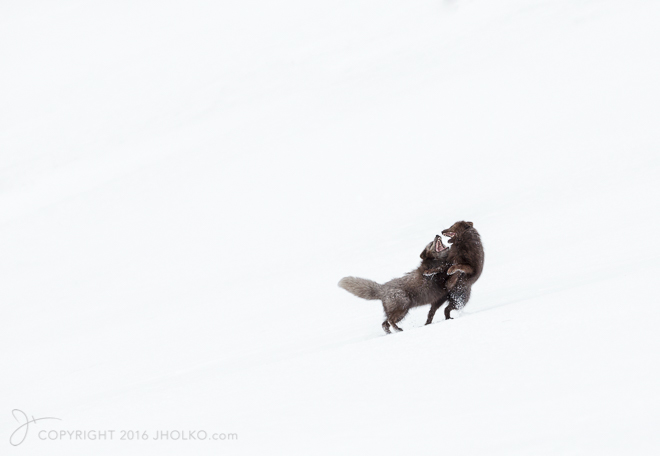 Svalbard in Winter by Snow Mobile – March 18th to March 23rd 2019 – SOLD OUT
In March of 2019 I am leading a sold out invitation only expedition to Svalbard to photograph winter landscape by snowmobile.
Svalbard in Winter – March 26th to April 3rd 2019 – SOLD OUT
In late March of 2019 I will lead my annual winter expedition north of Svalbard in search of Polar Bears, Walrus, Arctic Fox and dramatic winter landscape.
Great Ocean Road and Tasmania I – May 10th to May 21st 2019 – SOLD OUT
In May of 2019 I will co-lead a brand new workshop to the Great Ocean Road and Tasmania with professional Photographer and friend Phillip Bartlett. This workshop is sold out. Details on the second workshop are included below.
Great Ocean Road and Tasmania II – June 1st to June 12th 2019 – 3 Places
Due to initial demand Phillip and I will be running a second workshop to the Great Ocean Road and Tasmania. The workshop is strictly limited to no more than six photographers and has been designed to provide the very best photographic experience in some of the best locations across the Great Ocean Road and Tasmania. It is for photographers looking for a fantastic experience who want to be in the right place at the right time – when the light is at its absolute best.
This photography workshop will last for twelve days (eleven nights). We will be staying in high quality accommodation with private rooms and bathrooms for each person at each location. Breakfast and dinners will usually be held either at our hotels or nearby restaurants. However, this workshop is all about photography and we will be putting in some long hours in the field in order to ensure we give ourselves the best possible opportunities to capture dramatic and powerful photographs. We may take food and drink with us into the field in some areas to ensure we are in position and ready to photograph during the best light of the day. In May we will have sunrise at approximately 7:00am and sunset around 5:30pm giving us plenty of time for photography. We will be working in the style of professional landscape photographers and as such we will be most active during the early mornings and late evenings. Our transportation for the duration of the workshop will be in large, comfortable 4-Wheel Drive vehicles (three participants per vehicle plus one guide driver). Each vehicle has sufficient space for our luggage and camera equipment.
If you are interested in joining us and securing one of the last remaining places you can download a complete itinerary with costings and all details HERE.

Svalbard the High Arctic – July 13th to July 22nd 2019 – 6 Places
The High Arctic is a place to inspire the imagination. Nowhere is it more accessible than the Norwegian archipelago of Svalbard, located deep within the Arctic Circle. Nowhere else can the Polar Bear be seen more reliably in its natural habitat, and photographing these magnificent animals and the dramatic polar landscape will be our main objective. We will also search for walrus and the other wildlife of the region. Dramatic glaciers, plunging cliffs and beautiful drift ice formations will all be present as well.
This expedition has been designed to provide the very best possible opportunities to Photograph Polar Bears in their natural environment. With the reduction in Arctic sea ice the Polar Bears in Svalbard are dwindling in number and the number of years left to photograph them is unfortunately limited. June and July is the ideal time to photograph Polar Bears north of Svalbard due to the dwindling sea ice around the archipelago. This exclusive expedition is for a strictly limited number of just 12 participants plus leader and is dedicated to the photography of the High Arctic.
Our intention is to sail directly north from the small town of Longyearbyen in Svalbard to approximately 80o degrees north, to the very edge of the permanent pack ice. At our northerly most point we will likely be less than 600 miles from the North Pole and depending on the sea ice we may get even closer. We will be using the ice hardened expedition ship M.S Freya that will enable us to skirt the edge of the pack ice searching for and photographing landscape and Polar Bears. M.S Freya is widely regarded as one of the best ships in the Arctic for Photography. With low-lying decks we can photograph at eye level with wild Polar Bears and other wildlife. Our expedition ship is also equipped with sufficient zodiacs (2 x Zodiac MKV models) and crew for all photographers to be shooting simultaneously with plenty of room to spare for camera equipment – So bring what you need!
If you are excited by the idea of traveling to the edge of the permanent pack ice to photograph dramatic polar landscapes and Polar Bears in their natural environment with a small group of dedicated photographers now is the time to secure your place. The remaining places are very limited and once they are spoken for that’s it. On this expedition we will also likely photograph Walrus, Seals, Whales, Arctic Foxes and the many Arctic sea birds including the rare and angelic Ivory Gull.
If you are interested in joining us and securing one of the last remaining places you can download a complete itinerary with costings and all details HERE. To get an idea of the sort of photographs you can make on this expedition be sure to check out my Svalbard Portfolio.
 Mystical Faroes – August 8th to August 16th 2019 – 3 Places
In August I am running a one time only workshop to the Faroe Islands. The Faroe Islands are comprised of eighteen small rugged and rocky islands located in the middle of the Atlantic Ocean, approximately halfway between Scotland and Iceland. The island’s position is unique and is the frame for breathtaking views; beautiful mountains, majestic fjords, dramatic sea cliffs; all in all a photographers paradise. The islands have a rich bird life, Including the largest colony of storm petrels in the world and over 305 bird species including Razor Bills and Atlantic Puffins.
This workshop is for dedicated landscape photographers who are willing to work for their images. A small group of participants (maximum of 6 plus leaders) guarantees a more personal and intimate experience than bigger tours can provide.
If you are interested in joining us and securing one of the last remaining places you can download a complete itinerary with costings and all details HERE.
Greenland I & II – September 4th to September 11th 2019 – 3 Places
September 11th to September 18th 2019 – 4 Places
In early September Daniel Bergmann and I will run two back-to-back expeditions to the remote east coast of Greenland.
Greenland is an incredible place to inspire the imagination and fuel your photographic desires. Home to some of the most extraordinary geology to be found on earth, the red and orange glacial scarred landscape of Greenland stands in stark contrast to the electric blue icebergs that carve off its many glaciers and drift slowly down its precipitous fjords.
We have chosen early to mid-September for our expeditions. This is the time of year when we can expect the Arctic vegetation to be in autumn colours and it’s also the time for soft golden light and potentially more interesting cloudscapes than during the summer, when it’s quite common to have just blue sky.
Our expeditions will take place in the Scoresbysund fjord system in Eastern Greenland, which is the largest and most spectacular fjord system on the planet. We’ll fly from Iceland to Constable Point where we’ll board the expedition schooner Donna Wood, which will be our home for 7 nights while we explore the fjords and circumnavigate Milne Land. We’ll then fly back to Iceland on the eight day.
Living on board the traditional sailing ship Donna Wood for seven amazing days is an experience in itself. It’s a perfect ship for exploring Scoresbysund. It’s small size allows us to navigate shallow bays and this beautiful two mast oak ship also acts as a strong photographic subject amongst large icebergs and towering mountains. The group size will be limited to just 11 participants plus the two leaders.
We will be photographing from the ship as we cruise the fjords but will also be making numerous landings where we’ll photograph from the coastlines or do walks on the Arctic tundra. We’ll also use the two Zodiacs on board to cruise among grounded icebergs, such as at Rødeø (Red Island).
If you are interested in joining us and securing one of the remaining places you can download a complete itinerary with costings and all details HERE. To get an idea of the sort of photographs you can make on this expedition be sure to check out my Greenland Portfolio.
 Antarctica The Ross Sea – January 10th to February 8th 2020
A sneak peak into 2020! The year is going to kick off with an extended expedition to the very rarely visited Ross Sea region of Antarctica!
Antarctica is miraculous; a remote, white continent of stark and beautiful desolation. For Nature photographers, Antarctica is without doubt the gold standard against which all other photography destinations are measured. Nowhere else on earth offers such incredible landscape and wildlife in such a pristine and remote environment. Best of all, our Ross Sea expedition will take us to some of the most spectacular and least visited areas of Antarctica. For photographers the Ross Sea is nothing short of virgin territory.
This expedition to Antarctica is a co-operation between Joshua Holko (Wild Nature Photo Travel) and Heritage Expeditions. The expedition is for a strictly limited number of 50 participants plus photography guides and expedition leader. We are utilizing the ice hardened expedition ship Spirit of Enderby with a highly experienced crew so that we can get as close as possible to giant icebergs for the best photographs. Our expedition ship is equipped with sufficient zodiacs and crew for all photographers to be shooting simultaneously with plenty of room to spare for camera equipment. So bring what you need!
The Ross Sea region of Antarctica is one of the most remote places on Planet Earth and one of the most fascinating places in the continent’s human history. With shipping restricted by impenetrable pack ice to just two brief months each austral summer, few people have ever visited this strange and beautiful territory, with opportunities for non- scientific personnel limited to a handful of tourist expedition ships. This expedition voyage is on its own fully equipped and ice-strengthened ship, crewed by some of the most experienced officers and sailors in the world and staffed by some of the most passionate and knowledgeable Guides. This is a unique opportunity to experience nature on a scale so grand there are no words to describe it.
We invite you to join us on a 30 day photography expedition to the Ross Sea, Antarctica in January 2020. Get ready for the ultimate Antarctica Ross Sea Expedition! If you are interested in joining us and securing one of the remaining places you can download a complete itinerary with costings and all details HERE.
 There are numerous other things in the early planning stages for 2020 and beyond and I will have more details over the coming months as things are firmed up. Stay tuned..
 Holko's Test